








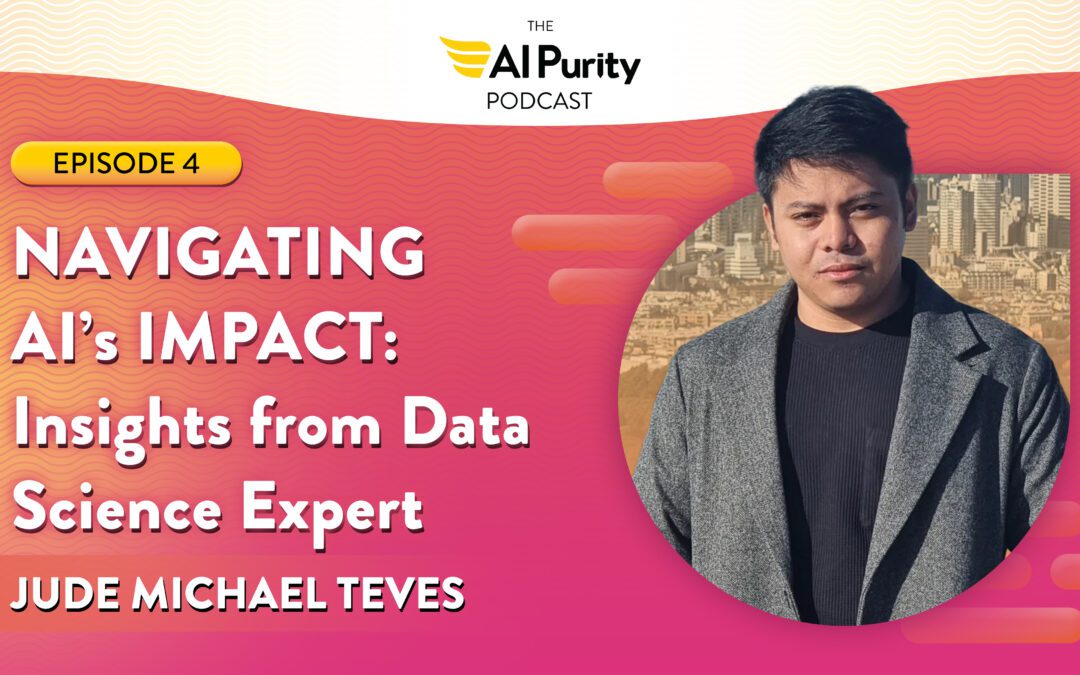
Data science expert, Jude Michael Teves is the featured guest for episode 4 of The AI Purity Podcast. Awarded Top Data Scientist by ASEAN’s The Center of Applied Data, Jude shares his wealth of knowledge on how AI is impacting education and financial institutions. Jude’s career in data science has led him to develop and teach courses as well as take his knowledge on leveraging AI tools in Asian financial institutions.
Jude’s Career Journey
Jude’s data scientist training started at the Asian Institute of Management. He pursued a degree in computer science and computer engineering but wanted to go beyond the regular confines of what his degree entailed. Jude recalls it being a “conscious effort” for him to also take machine learning courses so he could also focus on learning about artificial intelligence. Back then, AI and machine learning courses weren’t even part of the curriculum or mandatory to take. Jude’s career started when he became a software engineer right after graduating and his knowledge in AI led him to pursue his master’s data science degree.
What Is Data Science?
The Asian Institute of Management where Jude got his Master’s Degree was the first in the Philippines to offer a data science master’s degree and Jude was eager to learn. According to IBM, data science is an interdisciplinary field that combines math and statistics, specialized programming, advanced analytics, artificial intelligence, and machine learning to extract insights and knowledge from data that can be used for decision-making and strategic planning.
Jude’s master’s degree opened up an opportunity for him to start teaching and he even went on to develop curriculums in his alma mater. So how important is data science? Well, learning about this topic drives innovation because it uncovers patterns, trends, and correlations in data that can lead to the development of new inventions, products, services, or business models that can help organizations evolve amidst rapidly evolving markets. With analyzing data also comes the ability to identify inefficiencies and opportunities for optimization in processes, supply chains, and operations that can save costs and improve performance.
Jude On Developing A Machine Learning Course
Jude has been heavily involved in developing the curriculum for his alma mater’s data scientist degrees. With his experience with AI and machine learning, he even covers topics such as supervised machine learning, ChatGPT, and Midjourney. When asked how he balances introducing foundational concepts and exploring the latest AI advancements with his students he says that it’s quite tricky to balance the modern, the novel, and the fundamentals.
Jude underscores the importance of teaching the fundamentals to students like calculus and linear algebra, for example, to get a working understanding of the basics. Before his students get to machine learning courses, he teaches the basics of database and data mining to start. He says it’s so that when they get to machine learning, students are more prepared.
As students go through their data scientist training, Jude’s students are encouraged by him to play around with the tools that are available to them, especially the new ones. This even further highlights the importance of learning the basics for him. His teaching method provides his students with the fundamentals and then he lets them explore tools. Whether it’s experimenting with AI in his classroom, Jude doesn’t shy away from using new tools to teach his students. He has even assigned his students to use AI because it’ll show them the limitations of this technology and see that “it’s not perfect, sometimes, it’s [AI] making up facts.”
Get a short lesson on machine learning by reading our past blog “Machine Learning Applied In The Real World”.
Jude’s Advice For Tech Users In The Age Of Artificial Intelligence
On using AI tools, Jude said that we should not be afraid to leverage these tools while at the same time being wary of their limitations. AI technologies are not one we should be overly dependent on, and this goes for many students out there who rely on large language model chatbots to generate their assignments for them. “Let’s know the bounds, the limitations of these technologies that we’re using”, says Jude.
AI’s Positive Impact On Education
As a data science expert and an educator with experience in AI, Jude was the perfect candidate to ask about how AI impacts student learning. To this, Jude shared his observation that there was an increase in productivity. AI tools provide a new avenue for students to learn besides the traditional way of just reading from books for example. Jude understands that students learn in various ways and one method might not work on others, with AI tools being available, it might become a more effective way for student learning.
But with that, comes the responsibility for each student to keep up with ethical standards. Jude might advocate the use of AI tools, but he also advocates for its responsible use. On using AI tools, he says students should validate anything LLMs generate. “Check the sources. Make sure that what the AI is spitting out is real.” Jude says that students and anyone who uses large language model chatbots should not just rely on what is generated and take it as an accurate source without verifying it without actual reliable sources.
Practicing discernment in the age of generative AI is now more important than ever which is why AI Purity was created. Don’t just believe anything you read without being sure it isn’t AI-generated. For accurate AI detection, check out AI Purity’s premium versions and see which tier is best suited for your needs.
Preparing The Next Generation of Data Scientists
When asked about how Jude envisions the future of education whether it’s in the form of curriculum development or changing teaching methodologies, Jude says that he foresees a focus on applications that showcase the nuances of the subject matter instead of focusing on typical skill sets.
AI tools when embraced and applied ethically in educational settings could help educators focus on more than just teaching the basics. Jude’s current method of teaching still involves typical lectures but he augments teaching data science with other reliable resources and tools. For example, teaching programming can involve tools like DataCamp for typical syntax. Jude says there are more tools out there on the Internet that are free to use but the lessons educators provide inside the classroom will remain invaluable.
Educators can allow their students to explore but not without arming them with the knowledge to safely use the tools. Jude shares a misconception about AI that students might have which is that “it’s magic”. When educators are open about these tools, they demystify these kinds of misconceptions and teach students how to use them, how they work, and how to develop them.
Listen To The AI Purity Podcast
Listen to Episode 4 of The AI Purity Podcast to know more about how AI impacts not just educational institutions but also financial ones as Jude shares his experience working in the industry. There’s much to learn about how AI is leveraged in finance, lessons on data privacy, and more.
Check out our previous episode featuring Canada’s National Observer’s Marc Fawcett-Atkinson on “AI’s Impact On Ethical Journalism & Disinformation” to stay updated on The AI Purity Podcast.
For accurate and reliable AI text detection, use AI Purity today to unmask AI-generated text and help preserve original human-made content.